What Is Spotting In Animation? By Neil Blevins Created On: Feb 15th 2026 Updated On: Mar 28th 2026 Software: None
Spotting in animation is the process by which one person or department
later in production looks at earlier material (such as a script,
storyboards or concept art) and creates a list of all
assets that will be required for the project.
For example, the concept
team will take the script to a film and make a list of everything it
needs to design. Or the environment department will take some rough
concept art and make a list of every asset it will need to create to
make the final environment. Or the materials team on a large project
spotting different materials they'll need to develop for the film.
This
is an important part of the animation
process allowing a team to organize and get a sense of the scope of
what will be needed. While we're talking about animation here, a
similar process happens for videogames and VFX films.
You have two choices with this lesson, watch the video below, or
read the full text.
Spotting Or Bidding?
So sometimes the spotting process is referred to as an asset breakdown,
VFX spotting (when you're working on the visual effects for a live
action film), or
sometimes bidding. However, bidding is subtly different. The process
in bidding is identifying the assets, but then also assigning each the
time/money it will take to design/produce those assets. Some groups
split the
spotting and bidding process into 2 separate events. Others combine the
two and just call it bidding. But for this lesson we will focus just on
the spotting aspect.
Example 1
Let's do an example. Say I am doing concept design for an animation
based on the book project "The Story Of Inc". I need to know what I'll
need to design. So I go through the script from the book and start
breaking it down. Here's an excerpt from a scene in the book:
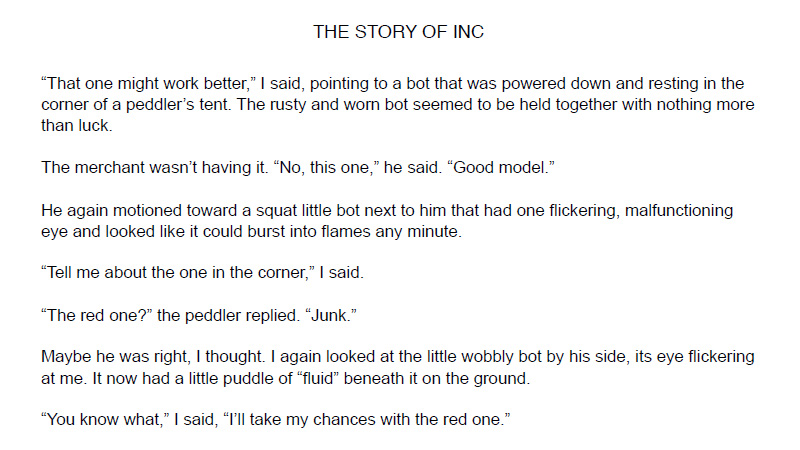
So from this little bit of the script, we can start making our list.
First are characters. We have the narrator, so we'll need to design
them. Then we have a merchant. Then we have at least two robots, the
squat robot, and a red robot that the narrator eventually picks. Likely
a few extra background robots too.
Next lets do environments / props. In the first paragraph we see we're
in a peddler's tent. So we'll need a tent. Then since there are robots
in the tent, we can imagine there's likely to be robot parts sitting
around the tent too for sale. Maybe an area of the tent where robots
are repaired, meaning we need repair tools. Then we might need tables
or chairs to sit on, work on, or stand behind. And finally there's
mention of a puddle of fluid on the ground.
So in a spotting session
for this scene, you might end up with a list like this...
Robot Tent Scene:
Characters
Narrator
Merchant
Squat Robot
Red Robot
Environment
Tent Interior
Props
Background robots
assorted robot parts
tables / chairs
robot repair tools
liquid puddle
Now with this list, the concept artist has a checklist of what needs to
be designed in order for the next stage of production to be able to do
their work more efficiently.
Example 2
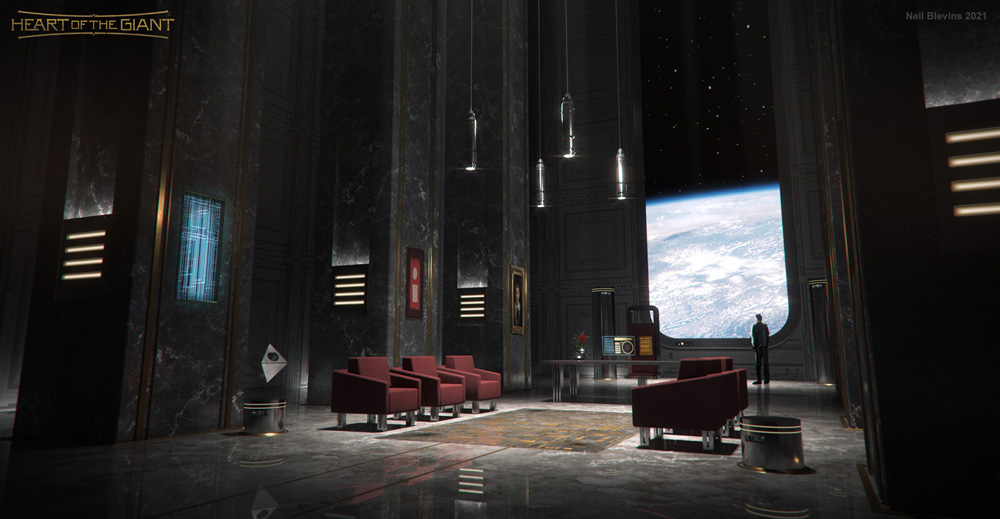
Say you're part of the Environment team, and rather than
the concept team handing you separate designs of each and every prop,
you get a
single concept painting (key art) of a scene, and your job is to model
/ texture that scene. Here's an example environment:
We break things down in a similar way:
Scifi Executive Office:
Environment
Office Architecture
Props
Sitting Chairs
Executive Chair
Desk
Wall Paintings
Hanging Lights
Flower Vase on desk
computer readouts
Pedestals
Modern Art
Different Spotting Sessions For
Different Departments
Spotting is important for both small and large productions. Whether you
are a team of 5 people or a team of 500, the only difference is how you
break up the task. For example, if you're a large team, you
might have a bunch of different spotting sessions, one for the
character team, one for the environment team, one for the fx team, etc,
and each only focuses on the part of the project you are responsible
for. If you're a smaller crew, maybe you need to produce both the
characters and environments yourself. Nothing changes, it's just you
spot both types of assets instead of just one.
Things Change
Also keep in mind that things will change. When you spot early in the
production process, you will end up with one list. While you're making
the assets on that list, a scene may change, or a scene could be added
or deleted
all together. In which case you need to go back and respot, fixing your
list. Productions are not linear, a script isn't 100% finished before
people are already building assets, so be prepared for revisions, that
asset you've been working on for the past 2 weeks might be cut
from the film. Sadly, that's just part of the way this works.
Bidding & Reality Check
If you haven't done bidding as part of your spotting, next will be
to bid the list, deciding approx how long each asset will take to
produce. This can also be a big reality check, lets say after bidding
you realize you have 5 times more objects to make than you have budget
/ time to produce them. That's where you might decide not to take the
project if you're a subcontractor, or ask for more money, or to ask if
some of the assets can be removed from project so you can do it for the
budget. The spotting process makes it far easier to know the true scope
of the project, which is vital to getting it done.
Conclusion
Spotting is an invaluable part of making a successful project, it helps
align teams and keeps things organized, even as the script changes
underneath you. So make sure to give it the focus it deserves, you'll
save a lot of time later on.